

How to read NightWin odds: fractions, decimals and returns
NightWin quotes odds as fractions, such as 10/1 or 23/25. The fraction is profit against stake: 10/1 pays £10 profit for every £1 staked, plus the stake back. To convert to decimal, divide the two numbers and add one, so 23/25 becomes 1.92.
Updated · by Night Win Casino · How we check facts
On this page
- NightWin odds converted: six real prices and their returns
- Why NightWin uses fractional odds
- Can you switch NightWin to decimal odds?
- Fractional, decimal and American odds side by side
- Implied probability and the book’s margin, worked through
- Odds-reading mistakes and how to avoid them
- NightWin odds questions
NightWin odds converted: six real prices and their returns
Every fraction below is one NightWin has actually printed. The middle column is our arithmetic rather than anything the operator displays, and the third is the same sum expressed in money.
| The NightWin price | As a decimal | £10 stake returns | Of which profit |
|---|---|---|---|
| 1/4 | 1.25 | £12.50 | £2.50 |
| 23/25 | 1.92 | £19.20 | £9.20 |
| 47/50 | 1.94 | £19.40 | £9.40 |
| 63/25 | 3.52 | £35.20 | £25.20 |
| 91/20 | 5.55 | £55.50 | £45.50 |
| 10/1 | 11.00 | £110.00 | £100.00 |
The rule behind every row is the same one. A fraction says how much profit a stake returns: ten to one pays ten times the stake in profit and hands the stake back on top, which is why the decimal equivalent is eleven rather than ten. One to four pays a quarter of the stake in profit, so a ten pound stake comes back as twelve fifty.
That single difference — profit against total return — is the whole of what separates the two conventions. A decimal already includes the stake; a fraction does not. Everything else is arithmetic.
Two shorthand points make the rest of the reading quick. When the left number is larger than the right, a win returns more than double the stake; when it is smaller, the price is odds-on and a win returns less than double. Evens sits exactly between the two, so a NightWin price around one to one is the dividing line of any market.
Why NightWin uses fractional odds
A platform serving more than one market has to pick a default, and which one it picks is readable off the setting itself.
- Reading a price as a return on what you put down, in one glance
- Multiplying out across a coupon in your head, which is why bookmakers kept them
- Expressing odds-on prices plainly, where a decimal turns into a figure between one and two
- Matching how prices are spoken aloud in Britain and Ireland
- The default lands where accounts used to fractional pricing already are
- Cricket ranks third among the named sports, and the account opens in sterling
- Three signals of the same thing, none of which prove it alone
- None of it is advertised anywhere, which is what makes it worth reading
The format has a cost worth knowing about. A fraction is slower to compare against another fraction than two decimals are, and on a live market that costs seconds. Anyone who thinks in decimals will find the NightWin book harder to scan for the first hour or so.
The odd-looking members of the family are the ones that give the game away. Nothing in a hand-set price list produces forty-seven to fifty; that figure exists because a live decimal price was converted into the nearest sensible ratio of whole numbers. Tidy fractions everywhere would mean prices copied off a chart. Forty-seven to fifty means they are coming off a feed.
Can you switch NightWin to decimal odds?
This matters enough to state on its own rather than in a footnote.
NightWin publishes fractions as the default. The middle column of the table above is our own conversion, printed for anyone who reads decimals faster.
The distinction is worth keeping because it is the sort of thing that quietly becomes a claim. A conversion table sitting next to an operator's name reads, at a glance, as though the operator offers both. Plenty of books do. What this one carries is written into the account itself, which is the place to check it.
A display preference, if the platform carries one, lives in the account settings after signing in.
The convention earns its keep in one specific way on this book. Three of the five sections NightWin puts on the front of its lobby exist to combine selections, which makes coupon-building the expected behaviour rather than an advanced one. Multiplying fractions across a coupon is exactly the sum British bookmakers kept the format for, so the default and the tools are pointing the same way.
For anyone arriving from a decimal habit, the practical answer is that ten minutes with the table above covers most of what a live book will show. Prices cluster: short favourites sit in the odds-on range, the middle of a market runs between about evens and three to one, and outsiders climb from there. Recognising a dozen common ratios by sight is enough, and the rest can be worked out on the spot.
The one habit worth forming deliberately is reading the second number rather than the first. A price of ninety-one to twenty looks intimidating and is simply a shade over four and a half to one; the denominator is doing all the work, and once it is being read the awkward-looking fractions stop being awkward.
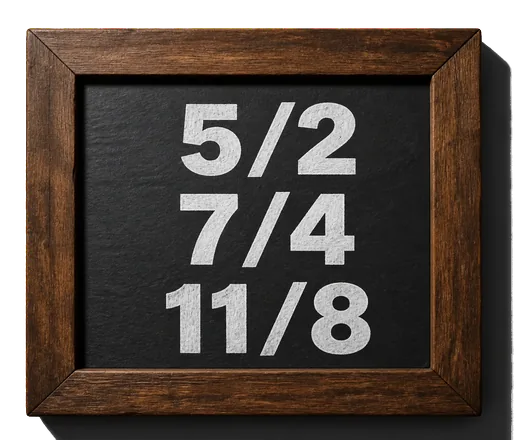
Fractional, decimal and American odds side by side
Eleven common fractions with their decimal and American equivalents and the probability each one implies. Learn the shape of this chart and most NightWin prices read at sight.
| Fractional | Decimal | American | Implied chance |
|---|---|---|---|
| 1/5 | 1.20 | −500 | 83.3% |
| 1/2 | 1.50 | −200 | 66.7% |
| 4/6 | 1.67 | −150 | 60.0% |
| 10/11 | 1.91 | −110 | 52.4% |
| Evens (1/1) | 2.00 | +100 | 50.0% |
| 6/4 | 2.50 | +150 | 40.0% |
| 2/1 | 3.00 | +200 | 33.3% |
| 5/2 | 3.50 | +250 | 28.6% |
| 3/1 | 4.00 | +300 | 25.0% |
| 5/1 | 6.00 | +500 | 16.7% |
| 10/1 | 11.00 | +1000 | 9.1% |
Implied chance for a fraction a/b is b ÷ (a + b): 6/4 is 4 ÷ 10, or 40%. For a decimal it is 1 ÷ the decimal: 2.50 gives 40% too. American odds show the profit on a $100 stake when positive (+150 means $150 profit) and the stake needed to win $100 when negative (−200 means staking $200 to win $100).
Going back from decimal to a fraction: subtract one and write what is left as a fraction. 2.75 becomes 1.75, which is 7/4; 1.40 becomes 0.40, which is 2/5. When the result is not a tidy ratio, books round to the nearest one, which is where prices such as 47/50 come from.
Implied probability and the book’s margin, worked through
Turn every price in a market into a percentage and add them up. The total will be over 100%, and the excess is the margin built into the market.
| Outcome | Price | Implied chance |
|---|---|---|
| Home win | 11/10 | 47.6% |
| Draw | 12/5 | 29.4% |
| Away win | 5/2 | 28.6% |
| Total | – | 105.6% |
The three outcomes cover everything that can happen, so in a market with no margin they would add up to exactly 100%. Here they add up to 105.6%, which means the prices are a little shorter than the chances behind them. That 5.6% is called the overround. NightWin does not publish its margins, but the same sum can be done on any of its markets in a few seconds, and it is the cleanest way to compare how generous two markets are.
Multiplying fractions across a coupon
Accumulators are where the format shows its age and its use. Convert each price to a decimal, multiply, then subtract one to get back to a fraction. A double at 1/2 and 4/5 is 1.50 × 1.80 = 2.70, or 17/10, so £10 returns £27. Add a third leg at evens and it becomes 2.70 × 2.00 = 5.40, or 22/5, and £10 returns £54. Every leg must win for the coupon to pay; the Bet Builder guide explains why legs from the same match are priced differently.
Odds-reading mistakes and how to avoid them
Fractions are simple once read the right way round. These are the errors people make in the first week.
- Reading 1/4 as 4/1. The first number is the profit. 1/4 returns £12.50 on £10; 4/1 returns £50.
- Comparing a fraction with a decimal directly. 2/1 and 2.00 are not the same price: 2/1 is 3.00 in decimal, while 2.00 is evens.
- Forgetting the stake in the return. A fraction shows profit only; the stake comes back on top when the bet wins.
- Treating a long price as good value because it is long. A price is only generous if the chance behind it is better than the chance it implies.
- Reading a live price without the clock. In play, the same fraction means something different at minute 10 and minute 85; the in-play guide shows a worked match.
Odds terms in plain words
- Odds-on – a price below evens, such as 1/2; a win returns less than double the stake.
- Odds-against – a price above evens, such as 3/1; a win returns more than double.
- Evens – 1/1, or 2.00 in decimal; the profit equals the stake.
- Short and long – a short price is a likely outcome, a long price an unlikely one.
- Drift and shorten – a price that lengthens has drifted; one that falls has shortened, usually because money or events moved it.
- Overround – the amount by which a market’s implied chances add up to more than 100%.
NightWin odds questions
Quick answers for anyone used to decimal odds.
Divide the first number by the second and add one. 10/1 is 11.00, 1/4 is 1.25 and 23/25 is 1.92.
A winning £10 stake at 10/1 returns £110: £100 profit plus the £10 stake.
Fractions are the platform default. Any display option would be in the account settings after signing in; the decimal column on this page is our own conversion.
A price where the first number is smaller than the second, such as 1/4. A win returns less than double the stake.
Divide the second number by the sum of both numbers. 6/4 implies 4 ÷ 10, or 40%; 1/4 implies 4 ÷ 5, or 80%. For a decimal price, divide 1 by the decimal.
Odds-against fractions become positive American odds showing profit on 100: 3/1 is +300. Odds-on fractions become negative ones showing the stake needed to win 100: 1/2 is −200. Evens is +100.
NightWin does not publish margins. You can measure one yourself: convert every price in a market to an implied percentage and add them up. Anything above 100% is the margin, for example 105.6% means a 5.6% overround.
Yes, just. The first number is smaller than the second, so a win returns less than double the stake: £11 at 10/11 returns £21. In decimal it is about 1.91, an implied chance of 52.4%.
Decimal = (first number ÷ second number) + 1. Everything else is practice.
Below 1/1 a win returns less than double the stake; above it, more than double.